
Hop Aero is building a rocket that launches out of a shipping container and lands on ground that was never prepared to receive it. The pitch is not speed for its own sake. It is the removal of the one piece of infrastructure that has controlled military and disaster logistics for a century: the runway.
Move cargo fast into a place that does not want you there and the constraint is almost never the vehicle. It is the runway.
A C-17 needs roughly two kilometres of paved surface, air traffic clearance, and a base willing to let it land. Deny the runway, whether through war, weather, or a collapsed bridge, and the fastest cargo plane on earth is a grounded asset. This is why disaster relief stalls at washed-out airstrips and why militaries spend enormous sums defending a handful of forward airfields: the whole supply chain depends on that one strip of concrete surviving.
It is also why, in a contested war zone, the airfield is usually the first thing an adversary tries to close, the same battlefield-denial logic behind Epirus building microwave weapons to end the drone age. Crater the runway and you have not damaged the cargo plane at all. You have made it irrelevant, because it has nowhere left to land.
Hop Aero’s answer is to stop needing it.
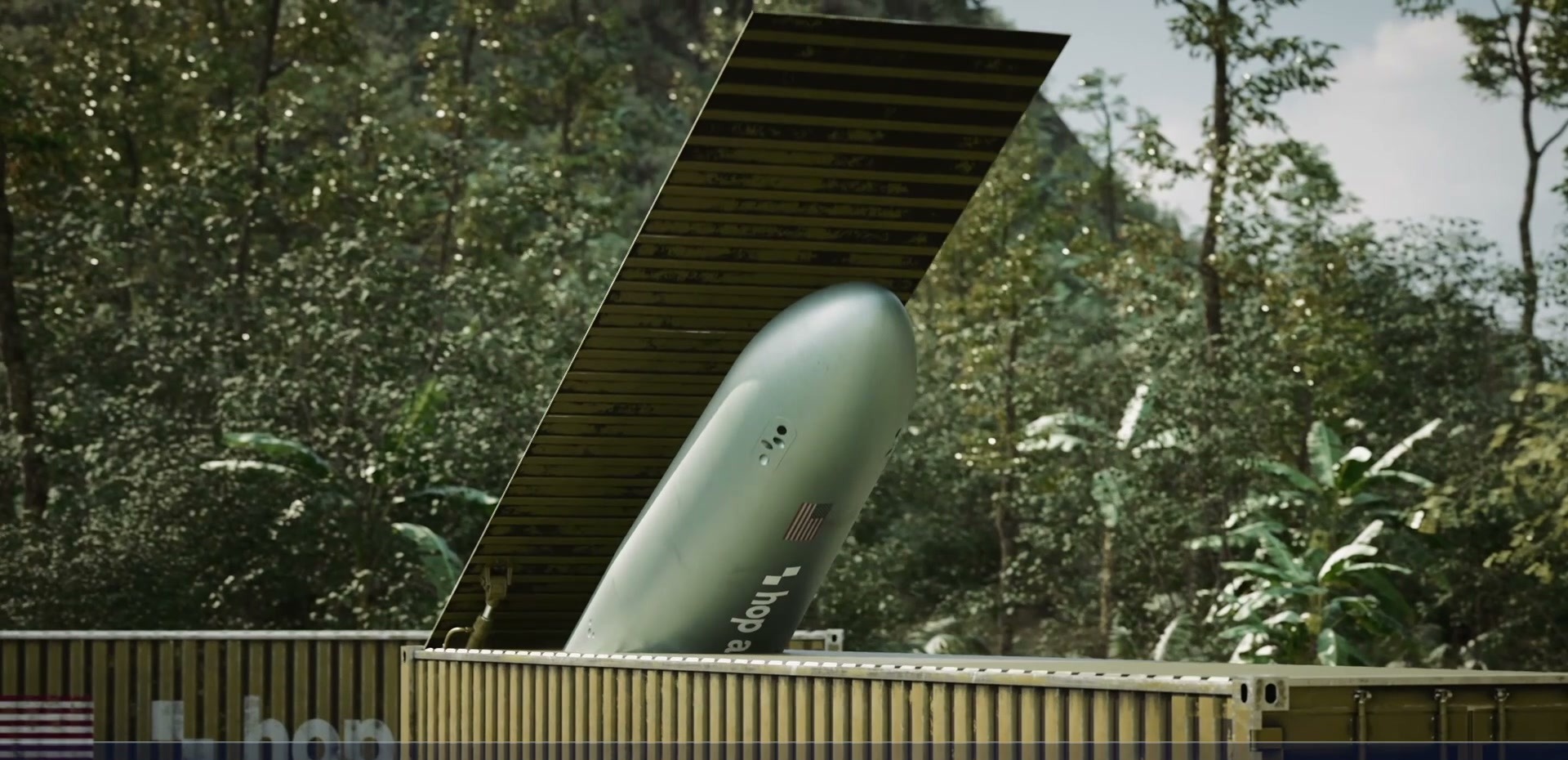
A machine built to skip the runway
Hop Aero was founded in 2024 by Matija Milenovic, who runs the company as CEO, and Jacob Balaj, who is CTO. Its product is Rook, an autonomous rocket roughly six metres tall, designed to carry 250 kilograms of cargo up to 750 kilometres away in about fifteen minutes.
The idea is to remove every fixed point an adversary or a disaster could take away. Rook launches out of a standard 40-foot shipping container, so the launch site is wherever the container is parked. It flies a suborbital arc, re-enters at hypersonic speed, and is designed to land on unprepared ground: no runway, no fixed pad, no forward base to defend.
That combination is the whole pitch. A shipping container can sit on a flatbed truck, a barge, or the deck of a ship, which means the launch point moves with whatever is already moving cargo. The vehicle is disposable infrastructure pointed at a problem that has historically required permanent infrastructure: an airstrip long enough for a transport plane, a base secure enough to operate it from, and the air and ground defence to keep both alive.
Milenovic told Payload Space that if the US military has this problem, all the way down to a small startup having the same problem, there is probably a large market in between. The company’s stated targets are the two ends of that spectrum at once: military resupply into contested territory, and time-critical parts for industries such as manufacturing, offshore oil and pharma, where Hop Aero says downtime can cost up to $2 million an hour.
Hop Aero, by the numbers
| Founded | 2024, by Matija Milenovic (CEO) and Jacob Balaj (CTO) |
|---|---|
| Rook | ~6m tall, 250kg cargo, up to 750km range, ~15 min flight time |
| Launch | Standard 40-foot shipping container; lands on unprepared ground |
| Team | Six employees, based in Los Angeles |
| Backing | Y Combinator, Summer 2026 batch |
| Contract | $1.25M Direct-to-Phase-II SBIR, Air Force Research Laboratory, awarded September 2025 |
The proof so far, and the gap that remains
The Air Force money is specific. It runs through AFRL’s Direct-to-Phase-II SBIR track, which lets a company skip the usual Phase I research stage, under a project called Rapid Operations Over Kilometers (ROOK, the same name as the vehicle). Payload Space reports the award at $1.25 million; no public federal contract database yet lists a more precise figure or a period of performance for it. It is a research and development contract, not an order for finished vehicles, and by most reporting it is Hop Aero’s only government funding to date, alongside its Y Combinator investment.
Against that contract, the company has hot-fired Rook’s engine and igniter and flown a tether test of a small-scale, roughly three-metre prototype at the Infinity One spaceport in Oklahoma. Hop Aero says it took about two months to go from engine design to hot-fire, using an in-house software stack it calls hopOS.
What has not happened yet is the flight that would settle the argument: Rook has not flown its full profile, and no company, Hop Aero included, has yet flown a licensed commercial point-to-point cargo delivery by rocket. The tether test and the hot-fire are real, verifiable steps. They are also, by the company’s own admission to the trade press, still steps short of the thing being sold.
$1.25M
AFRL Direct-to-Phase-II SBIR contract, awarded September 2025
By most reporting, Hop Aero’s only confirmed government funding to date: a research award, not a purchase order. SBIR awards run for a fixed period of performance by design, though Hop Aero has not disclosed this one’s end date.
There is a regulatory distance here that is easy to skip past in a company description. Point-to-point rocket cargo, whatever the vehicle, has to clear airspace authorities and range-safety rules built for a world where almost nothing lands somewhere unprepared on purpose. Hop Aero is racing two clocks at once: the engineering clock, which it controls, and the regulatory clock, which it does not. The Air Force contract buys time against the first. It does not touch the second.
Two résumés built out of other companies’ endings

Milenovic did not arrive at rockets first. He previously founded porkchop, a Stockholm-based company building electric propulsion thrusters for small satellites, using what it called a micro vacuum arc thruster to let a spacecraft rendezvous with and dock to a client satellite. In January 2022, porkchop flew a scaled-down version of that thruster hardware to orbit on a SpaceX Falcon 9 rideshare mission, described elsewhere as Transporter-3, as reported by the European Space Agency’s own business-incubation programme, which had backed porkchop as a portfolio company rather than verifying it as an outside party. By his own account, via Hop Aero’s Y Combinator profile, he later sold the company’s IP and moved on; no independent press corroborates the sale itself. He holds a mechanical engineering degree from University College Dublin and a master’s in aerospace engineering from KTH in Stockholm, a path the Swedish outlet Warp News traces to watching SpaceX land a Falcon Heavy booster.
Balaj’s path runs through a different kind of proof. He started in avionics on MV-22 Osprey tiltrotors in the US Marine Corps, then moved through a sequence of hard-tech companies: SpaceX, on Falcon 9 and Falcon Heavy integration and test; Virgin Orbit, on the LauncherOne air-launched rocket; Masten Space Systems, leading integration and test on a lunar lander built for NASA’s Commercial Lunar Payload Services programme; and SpinLaunch, on satellite systems, the same SpaceX alumni network that keeps spinning out founders of its own.
Two of those employers did not survive him. Masten filed for Chapter 11 bankruptcy in July 2022, and its main lunar-lander assets were sold to Astrobotic, a direct competitor. Virgin Orbit, which Wall Street had valued at $3.2 to $3.7 billion via SPAC roughly a year and a half earlier, ceased operations and auctioned its assets in May 2023 for a little over $36 million, roughly one percent of that peak value. Balaj was, by the time each ending arrived, already somewhere else. That is a résumé built less on any single company’s success than on watching, at close range, several different ways a hard-tech company can die.
The two founders are, in effect, running the experiment from opposite directions. Milenovic has already taken one hardware company from founding to flight to a sold-off cap table, so he knows what the end of the road looks like when it goes well enough to close out on your own terms. Balaj has watched what it looks like when it does not, twice, from inside the integration and test team that has to keep flying hardware while the company around it runs out of runway of its own, the same contested-logistics problem Terra Industries is betting on becoming the next defense giant to solve.
Founder lessons from the launch pad
The infrastructure is the product, not the vehicle
What makes Rook interesting is what it refuses to need: a paved runway, a fixed base, a spot an adversary or a disaster can identify and remove. Hop Aero is not selling speed. It is selling independence from the one asset that every existing cargo option depends on. When you are attacking an incumbent system, look for the shared dependency everyone has stopped noticing, because it has been there so long it reads as a law of nature rather than a design choice. Every airlift plan, commercial or military, assumes a runway will still be there. Building around the assumption instead of inside it is the actual product.
A résumé of company deaths is not a résumé of failures
Balaj was on the integration and test team at two hard-tech companies that ended in bankruptcy, and at SpaceX and SpinLaunch, which did not. Hiring someone who watched two hard-tech companies fail from the inside is not a risk signal. It is the opposite: he has already seen, first-hand, which decisions kill a company like this one, and he did not need to learn it at Hop Aero’s expense. The market often prices survivors’ résumés as safer than they are and treats proximity to failure as contamination. It is usually the reverse.
Sell the market you can name, not the one you started with
Milenovic’s first company, porkchop, served one satellite niche small enough that he could describe the buyer in one sentence. Hop Aero’s pitch spans a US Air Force programme and an offshore oil rig’s spare-parts closet in the same breath, on the theory that if the most demanding customer imaginable has a problem, and the least demanding one has the same problem, the market in between is real and large. That is a bet on breadth over a proven pivot from a founder who has already built and sold one narrower company. It is worth watching whether Hop Aero can actually close both ends, or whether it eventually has to choose. A defence contract and an industrial spare-parts run have almost nothing in common operationally, beyond both currently lacking a rocket that can serve them.
A research contract is a deadline, not a cushion
The Air Force money is a research contract, and SBIR awards like this one run for a fixed period of performance by design, even though Hop Aero has not disclosed exactly when this one ends. That is a company financed by a countdown rather than a purchase order. The test-fire and the tether flight both happened inside that window, which is the correct way to read them: not as leisurely technical milestones, but as the fastest proof a small team could produce on a clock it does not control indefinitely.
Final word
The runway has been the quiet chokepoint of logistics for a hundred years: the thing every cargo plan assumes will still be there when the cargo arrives. Hop Aero’s bet is that removing that assumption is worth more than any improvement to the vehicle that flies over it.
Rook has not made its full flight yet. The hot-fire and the tether test are real, and they are also the easy part of a much harder argument that has not been settled in the air. Whether a container-launched rocket can actually clear the regulatory and physical distance between a lab test in Oklahoma and a resupply run into contested ground is the whole question the next year will answer.
It is a six-person company betting that the next war, or the next disaster, will be decided as much by what infrastructure a force does not need as by what it carries. That is a harder story to tell in a pitch deck than a faster rocket. It may also be the more durable one.
Sources
- Y Combinator, Hop Aero: Rocket cargo delivery to contested environments, ycombinator.com/companies/hop-aero
- Payload Space, Hop Aero Wants to Deliver Cargo via Rocket, Victoria Woodburn, July 30, 2026
- Tom’s Hardware, Shipping container-launched cargo rocket promises 550-pound deliveries 750 km away in 15 minutes, 2026
- ESA Commercialisation Gateway, When pigs fly: Stockholm-based “porkchop” reaches orbit on SpaceX rocket, March 2022 (ESA BIC Sweden was porkchop’s own incubator, not an independent verifier)
- Warp News, Porkchop wants to be the DHL of deep space, Mathias Sundin, April 1, 2022
- SpaceNews, Masten Space Systems files for bankruptcy, July 2022
- SpaceNews, Court approves sale of Masten assets to Astrobotic, 2022
- CNBC, Branson’s Virgin Orbit to go public through a SPAC at $3.7 billion valuation, August 23, 2021
- Axios / CNBC / StreetInsider, Virgin Orbit assets sold for roughly $36 million at auction, May 23-24, 2023
- Hop Aero, hopaero.com and Y Combinator company page
[…] a named defense customer, that private investors could later underwrite. It is the same route Hop Aero took with Air Force research money before it had flown anything, and the same one Radiant used to put a reactor on a truck. In […]