How Hadrian is Rebuilding the Supply Chain

Silicon Valley is currently obsessed with the new space race and the defense tech insurgency.
Founders are raising billions of dollars to build hypersonic jets, reusable rockets, and directed energy weapons like Epirus. But there is a massive, highly vulnerable choke point throttling this entire revolution.
If you want to build a rocket, you need precision-machined metal parts. And the supply chain responsible for making those parts is stuck in the 1950s.
Enter Hadrian.
Founded by Chris Power, Hadrian is building a highly automated, software-defined network of factories. They are not building the rockets themselves. They are building the industrial base required to make the rockets possible.
The Problem: The Mom-and-Pop Choke Point
When a multi-billion-dollar aerospace company needs a custom aluminum valve, they do not print it in a futuristic lab. They email a PDF drawing to a small, 15-person machine shop in Ohio or Texas.
The US aerospace supply chain is dominated by thousands of these fragmented “mom-and-pop” machine shops.
They are incredibly skilled, but they are also highly analog. They quote jobs using spreadsheets, they manage workflows on whiteboards, and their workforce is rapidly aging out toward retirement. This fragmentation creates a massive delay. Procuring a single part can take 60 to 90 days.
If you want to build a fleet of autonomous defense vehicles or launch weekly payloads into orbit, a 90-day wait time for a metal bracket is a fatal bottleneck.
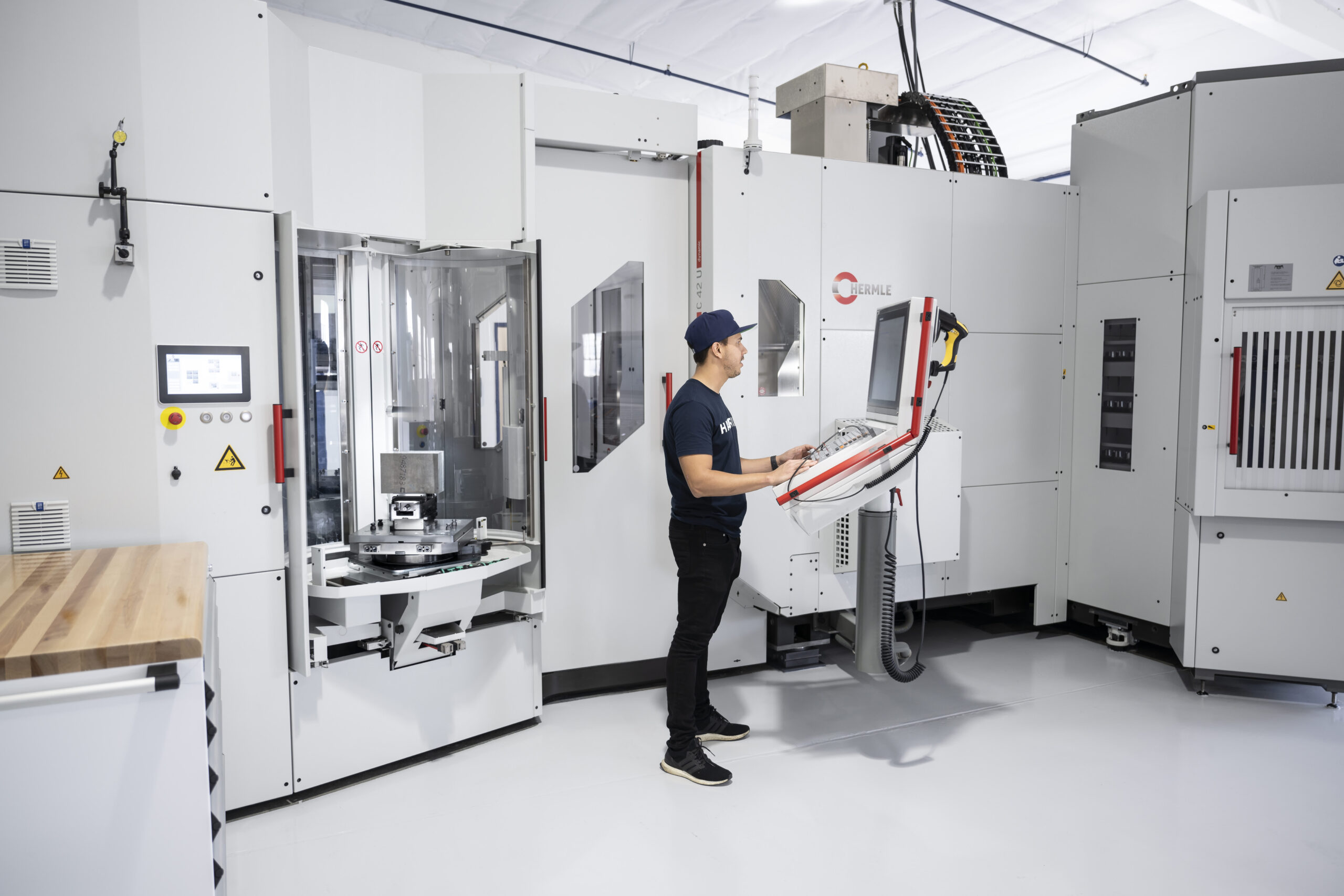
The Playbook: Software-Defined Manufacturing
Chris Power realized that to fix the aerospace industry, he had to build an entirely new type of machine shop.
Hadrian is applying modern software engineering to heavy industrial manufacturing, much like Revel applies software agility to hardware control.
Automating the Workflow
Hadrian does not rely on manual spreadsheets. They built a proprietary software engine that automates the entire manufacturing workflow. When an aerospace engineer uploads a CAD file to Hadrian, the software instantly analyzes the geometry, selects the correct cutting tools, and generates the machine code.
What used to take an expert machinist three days to quote and program now takes minutes.
The Factory OS
Inside a Hadrian factory, the machines are orchestrated by a centralized operating system. The software tracks every part, every tool, and every millimeter of material in real-time. By removing the manual administration that plagues traditional machine shops, Hadrian can deliver precision parts 10x faster than the legacy supply chain.

Founder Lessons: The Unsexy Infrastructure
1. Build the Picks and Shovels
During a gold rush, the highest leverage move is to sell the picks and shovels. While other founders compete to build the sexiest rocket, Chris Power chose to build the factory that supplies them all. Just as Terranox AI acts as the picks and shovels for the nuclear energy boom by finding uranium, Hadrian is securing the physical foundation for the space economy.
2. Follow The Algorithm
Hadrian is a masterclass in applying Elon Musk’s 5-Step Algorithm. Chris Power looked at the legacy machine shop and aggressively deleted the manual friction. He questioned the requirement of having human machinists calculate tool paths, optimized the flow of aluminum across the factory floor, and only then applied high-speed automation.
3. Solve for Fragmentation
When an industry relies on 3,000 disconnected, analog vendors, it is begging to be consolidated by software. The best founders look for highly fragmented markets and build a centralized platform that forces the industry into the modern era.
Final Word
The United States cannot maintain its edge in aerospace and defense if its manufacturing base is running on whiteboards and paper quotes.
Hadrian is proving that the future of hard tech is not just about designing cooler hardware. It is about fundamentally rethinking the factories that build the hardware. By turning the machine shop into a software-defined network, Chris Power is ensuring that the new industrial revolution actually has the parts it needs to launch.

Tumisang Bogwasi
Tumisang Bogwasi is an award-winning entrepreneur and strategist sharing insights on business growth, leadership, and innovation.