Form Energy, a Massachusetts company that stores electricity in rusting iron, announced a $750 million Series G on 12 August 2026. It says it has raised more than $2 billion in equity, and its backlog has grown from about 20 gigawatt-hours to 80.
Its first commercial system, a small pilot in Minnesota, is still not running.
The physical bottleneck is the gap between a battery that lasts hours and a grid that sometimes needs days. Form is betting that iron, air and water can close it.
Mateo Jaramillo and four co-founders started Form in 2017 to store power for days
Form was co-founded in 2017 in Somerville, Massachusetts. Yet-Ming Chiang is an MIT materials scientist. Mateo Jaramillo was a Tesla vice president. They met in 2016 at the CERAWeek conference in Houston and talked about how to store renewable power for long stretches, according to MIT’s materials department.
The other co-founders are Marco Ferrara and William Woodford, both MIT graduates, and Ted Wiley, an energy storage veteran. Jaramillo is chief executive. Ferrara’s modelling is credited with showing that multi-day storage below roughly $20 per kilowatt-hour could make wind and solar mixes competitive.
Tesla is a recurring thread in this series. Jaramillo ran Tesla’s energy storage business before he left, as POWER reported in 2022. For another Tesla storage alumnus building around the grid, read our piece on Drew Baglino’s Heron Power.
The real constraint on the grid is the weather that lasts longer than the battery
Lithium-ion batteries typically discharge for four to eight hours, according to GCN. That suits an evening peak. It does not suit a cold, still week when wind and solar both fall short.
Utilities usually cover that gap with gas turbines. Form’s pitch is a storage system that does the same job for up to 100 hours, which is just over four days, without burning fuel.
Jaramillo has said the company is aiming at the weather events that last the longest. The target market is a utility planner who needs capacity for a bad week, not a bad evening.
Form’s iron-air battery rusts and un-rusts iron, and the company says it costs a fraction of lithium
The chemistry is simple to describe. MIT explains that on discharge the battery takes in oxygen and turns iron into rust. Charging with electricity reverses it, turning rust back into iron and releasing oxygen.
Chiang put the ingredients in four words: “Just iron, air, and water.”
Iron is cheap and plentiful, and the battery avoids lithium, cobalt and nickel. That is the basis of the cost claim. MIT’s account gives Form’s target as about $20 per kilowatt-hour, roughly a tenth of lithium-ion storage. It is a target, not a delivered price.
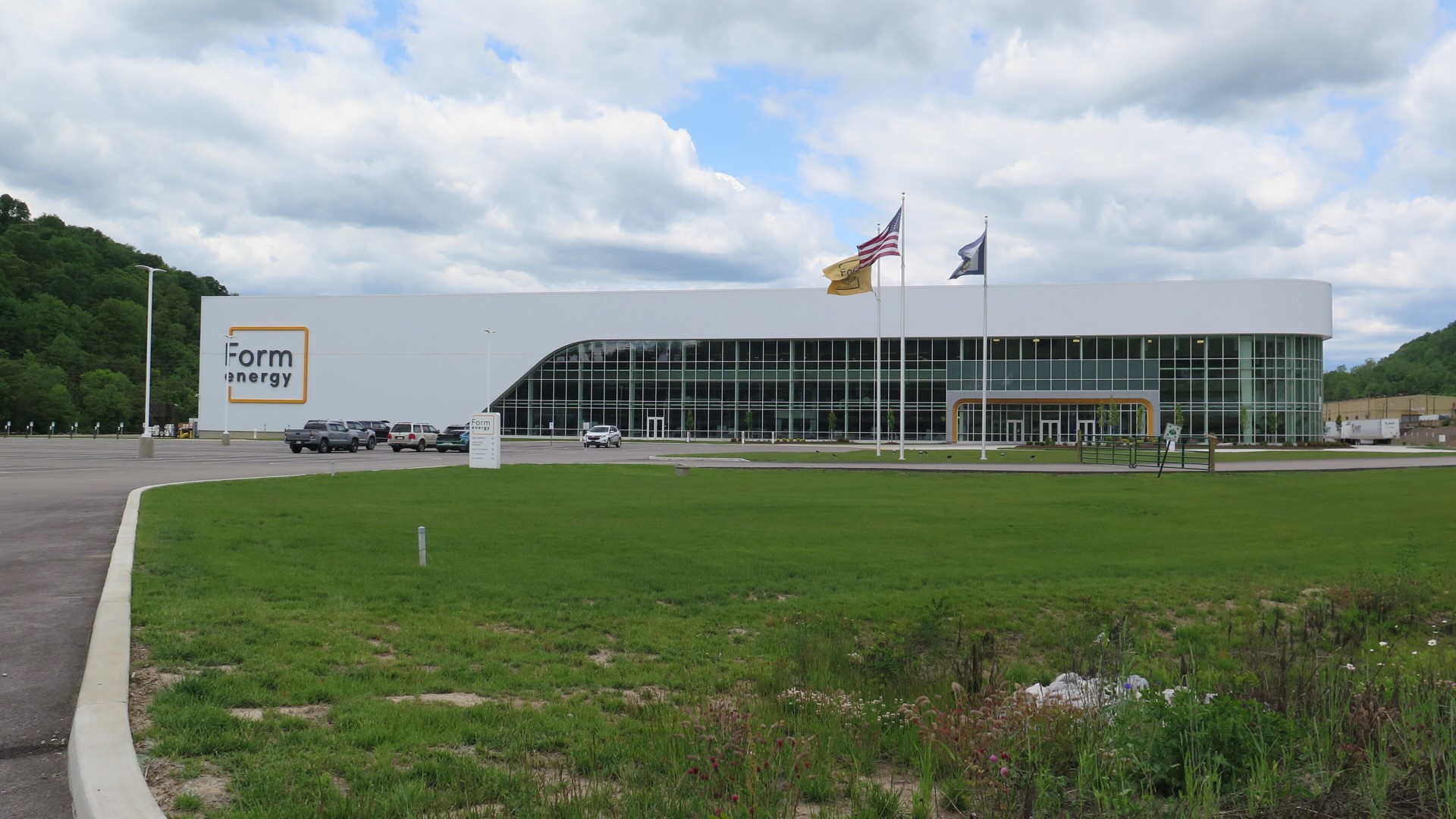
Form Factory 1 is a million-square-foot plant on a former steel mill site in Weirton
Form builds its batteries at Form Factory 1 in Weirton, West Virginia, on the site of the former Weirton Steel mill. The company describes it as one million square feet. Construction began in May 2023 under a 2022 plan promising 750 jobs and $760 million of investment.
West Virginia put up an incentive package of up to $290 million, tied to hiring. By Form’s own count in September 2026 it employed more than 450 people in Weirton and was hiring technicians for day and night shifts.
The plant is meant to reach 500 megawatts of annual capacity. Latitude Media reported in March that capacity was fully allocated for several years, and that Jaramillo expected a new large order to be filled in late 2028 or 2029. Canary Media puts the 500 megawatt milestone in 2028.
Investors have funded the factory in steps, and the Series G is the biggest yet
Form raised a $450 million Series E in October 2022, led by TPG Rise Climate. In October 2024 it closed a $405 million Series F. Form’s Series G release says T. Rowe Price led it, and Latitude Media named GE Vernova as a co-lead.
On 12 August 2026 came the $750 million Series G, again led by T. Rowe Price. New investors were Sequoia Capital, Janus Henderson, Franklin Templeton and PEAK6. Breakthrough Energy Ventures, Coatue, TPG Rise Climate and GE Vernova, among others, took part again.
Form did not disclose a valuation. Aggregator sites quote one, but none traces to a company statement, so we leave it out. On 21 September it added a $270 million credit facility from a syndicate led by Barclays.
Form Energy by the numbers
- Founded: 2017, Somerville, Massachusetts, by Mateo Jaramillo, Yet-Ming Chiang, Marco Ferrara, William Woodford and Ted Wiley
- Product: iron-air battery rated for 100 hours of discharge
- Series G: $750 million, 12 August 2026, led by T. Rowe Price
- Total equity raised: more than $2 billion, per the company
- Credit facility: $270 million, 21 September 2026
- Backlog: about 80 gigawatt-hours, up from about 20, per the company
- Weirton workforce: more than 450 people, September 2026
- Biggest order: 30 gigawatt-hours for a Google data centre in Minnesota, announced 24 February 2026
More than $2 billion raised, and the first commercial system is still being finished.
Google’s 30 gigawatt-hour order is the proof investors wanted, and it has conditions
On 24 February 2026 Xcel Energy announced that a Google data centre in Pine Island, Minnesota would be supported by 300 megawatts and 30 gigawatt-hours of Form’s batteries. Xcel called it the largest battery project by energy capacity announced anywhere.
Two conditions matter. The agreement needed approval from the Minnesota Public Utilities Commission, and we did not find a source confirming that it has been granted. Canary Media reports Form expects to begin delivering to Xcel in 2028, with installations arriving in phases to 2031.
Google pays for the new service and the new grid costs, and the battery’s price was undisclosed. That structure protects Xcel’s other customers. It also means nobody outside the deal can check the cost claim.
Crusoe, Ireland and the utilities show demand is broad, but the orders are small beside the claims
Form also announced 12 gigawatt-hours with AI infrastructure company Crusoe on 24 March 2026, with deliveries starting in 2027. On 17 March it signed a 10 megawatt, 1,000 megawatt-hour project with FuturEnergy Ireland for 2029, its first outside the United States.
Latitude Media listed Great River Energy, Xcel, Dominion Energy, Georgia Power, NYSERDA and the US Department of Energy among Form’s customers and partners in 2024. The pattern is clear: utilities and data centres both need power that holds for days. For a company attacking the same grid problem from the other side, see Base Power.
Commercial status is the honest weak point: the first project is late and efficiency is low
The first commercial system is a 1.5 megawatt, 150 megawatt-hour pilot for Great River Energy at Cambridge, Minnesota. Great River Energy said it expected operation by the end of 2025. It has not happened.
GCN reported on 28 October 2026 that Great River Energy’s May 2026 resource plan called the structures substantially complete, with modules still awaited and commercial operation targeted for the end of 2026. Form said in March that the pilot had begun delivery. Canary Media noted it was originally due online in 2023.
Efficiency is the second caveat. GCN puts round-trip efficiency at about 40 percent against about 90 percent for lithium-ion, while other outlets quote higher figures. The company’s argument is that cheap storage beats efficient storage when the energy stored is cheap.
Third, Form is not alone. Latitude Media reported that rival 100-hour companies are at pilot or demonstration stage, and that earlier long-duration storage firms that listed early struggled.
Founder lessons from Form Energy
Aim at the problem the incumbent technology cannot reach
Lithium-ion won the four-hour market. Form ignored it and built for the week-long gap. When a rival owns the obvious market, look for the duration, distance or scale where its product stops working.
Choose materials the world already has
Iron is cheap and everywhere. Building the cost case on a commodity let Form promise a price that a scarce-mineral battery cannot. A bottleneck you design around is worth more than one you pay to relieve.
Put the factory next to the customer’s politics
Weirton gave Form a site, a workforce with industrial history and a state willing to pay for jobs. The hiring condition tied the subsidy to results. Treat local incentives as a contract you must earn, not a gift.
Scale slowly when the product is new
Jaramillo told Latitude Media the company does not want to run into extremely high volumes overnight. A pilot that slips is cheaper to fix than a factory full of the wrong cell.
Final word
Form Energy shows how much money a credible physical idea can raise before the first unit earns anything. Investors have backed a chemistry, a factory and a set of orders from some of the biggest names in power and AI.
What is proven is the factory, the funding and the signed demand. What is unproven is a working commercial system, the cost target and the Google order’s approval. Watch Cambridge energising, the first Weirton shipments to Crusoe in 2027, and whether an IPO follows. Jaramillo has said there is no fixed date.
For a company building the physical power layer for the same AI boom, read about Fervo Energy and Bluecore Energy.
Sources
- Form Energy, Series G financing announcement, 12 August 2026
- Form Energy, $270 million credit facility, 21 September 2026
- Form Energy, technician hiring sprint in Weirton, September 2026
- Form Energy, new board members and production ramp, 13 November 2026
- Form Energy and Crusoe, 12 gigawatt-hour agreement, 24 March 2026
- Form Energy and FuturEnergy Ireland, 17 March 2026
- Xcel Energy, new Google data centre in Minnesota, 24 February 2026
- Canary Media, gigantic Form Energy battery to power Google data centre
- Latitude Media, is Form ready for the public market, 10 March 2026
- Latitude Media, Form Energy brings in more cash, 9 October 2024
- MIT Materials Science and Engineering, Power when the sun doesn’t shine
- GCN, A Minnesota battery pack is being built to run nonstop for 100 hours, 28 October 2026
- Great River Energy, Cambridge Energy Storage Project
- POWER, Form Energy picks West Virginia site for first factory, 23 December 2022
- Area Development, Form Energy in Weirton, 23 December 2022
- Photo: Cutlass, CC0, via Wikimedia Commons