The Withered Technology Doctrine: Why Nintendo Wins With Parts Nobody Else Wants
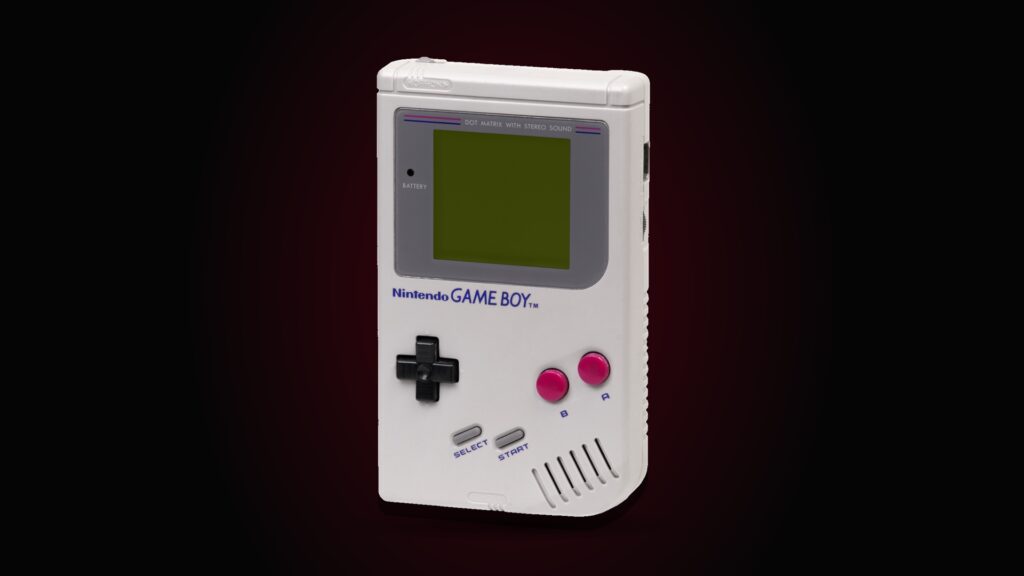
In 1989 Nintendo shipped a handheld games console with a grey monochrome screen for 89.99 dollars. Atari shipped one with a colour screen and better hardware for 179.99. Sega followed with colour at 149.99.
The Game Boy has sold 118.69 million units. Its two better-specified rivals are footnotes.
Nintendo did not win that fight by out-engineering anyone. It won by refusing to compete on engineering at all, and the doctrine behind that refusal is the most transferable idea the company has ever produced.
The Pain Point: The Specification Arms Race
Every hardware category, and increasingly every software one, drifts toward the same fight. Your competitor ships a faster processor, so you ship a faster one. They add a feature, you add two.
This fight has a defining characteristic: nobody can win it permanently, and everybody pays to stay in it.
Newest-generation components carry the highest unit cost, the least mature supply chain and the worst failure rates. Every upgrade cycle resets your margins and your reliability at the same time. You are paying a premium for the privilege of being a beta tester on your own production line, and your customer often cannot perceive the difference you paid for.
The trap is that the arms race feels like progress. It shows up in the product roadmap as ambition. It shows up on the income statement as compression.
A specification your competitor can also buy is not an advantage. It is a shared cost.
The Radical Story: Deliberately Using Old Parts
Gunpei Yokoi joined Nintendo as a maintenance engineer on the assembly line and became the designer behind the Game & Watch and the Game Boy. He gave his approach a name: lateral thinking with withered technology.
Withered technology means components that are mature, cheap, thoroughly understood and widely available. Lateral thinking means finding an application for them that nobody has tried. Yokoi’s position was that games do not require advanced technology. They require novel play, and advanced technology is often an obstacle to shipping it affordably.
The Game Boy is the doctrine in physical form. Yokoi refused a colour screen. Colour would have raised the price, complicated the supply chain and destroyed battery life.
That last constraint is the one that decided the market. The Game Boy ran roughly 30 hours on four AA batteries. Its colour rivals ran a few hours on six. For a device whose entire purpose is to be used away from a power outlet, battery life was not a specification. It was the product.
Atari’s Lynx and Sega’s Game Gear won every specification comparison in the magazines and lost the category completely.
Why It Worked
The advantage is financial before it is creative.
Mature components are cheap, so the bill of materials is low and the margin is wide. Mature components are well understood, so the failure rate is low and the warranty cost is low. Mature components have deep supply, so you can actually manufacture at volume when demand arrives.
Nintendo took the money it saved by not fighting the specification war and spent it where customers could actually perceive the difference: price, battery life, and games.
Satoru Iwata later described the same logic in market terms rather than engineering terms. Nintendo was not competing against Sony or Microsoft, he said. It was competing against the indifference of people with no interest in video games. You do not beat indifference with a faster processor. You beat it with a lower price and a reason to care.
The Wii proved the doctrine at scale. It shipped underpowered against the PlayStation 3 and Xbox 360, skipped high definition entirely, and sold 101.63 million units.
The Control Experiment: What Happened When Nintendo Stopped
Most strategy stories cannot be tested, because you never see the same company run the alternative. Nintendo ran it.
The Wii U abandoned the position. It chased the conventional console fight, arrived with a confused proposition, and sold 13.56 million units.
Same company. Same franchises. Same engineering talent. Roughly one seventh of the result.
Then Nintendo returned to the doctrine with the Switch, a device built on modest mobile hardware whose actual innovation was a use case rather than a specification, and sold 156.59 million.
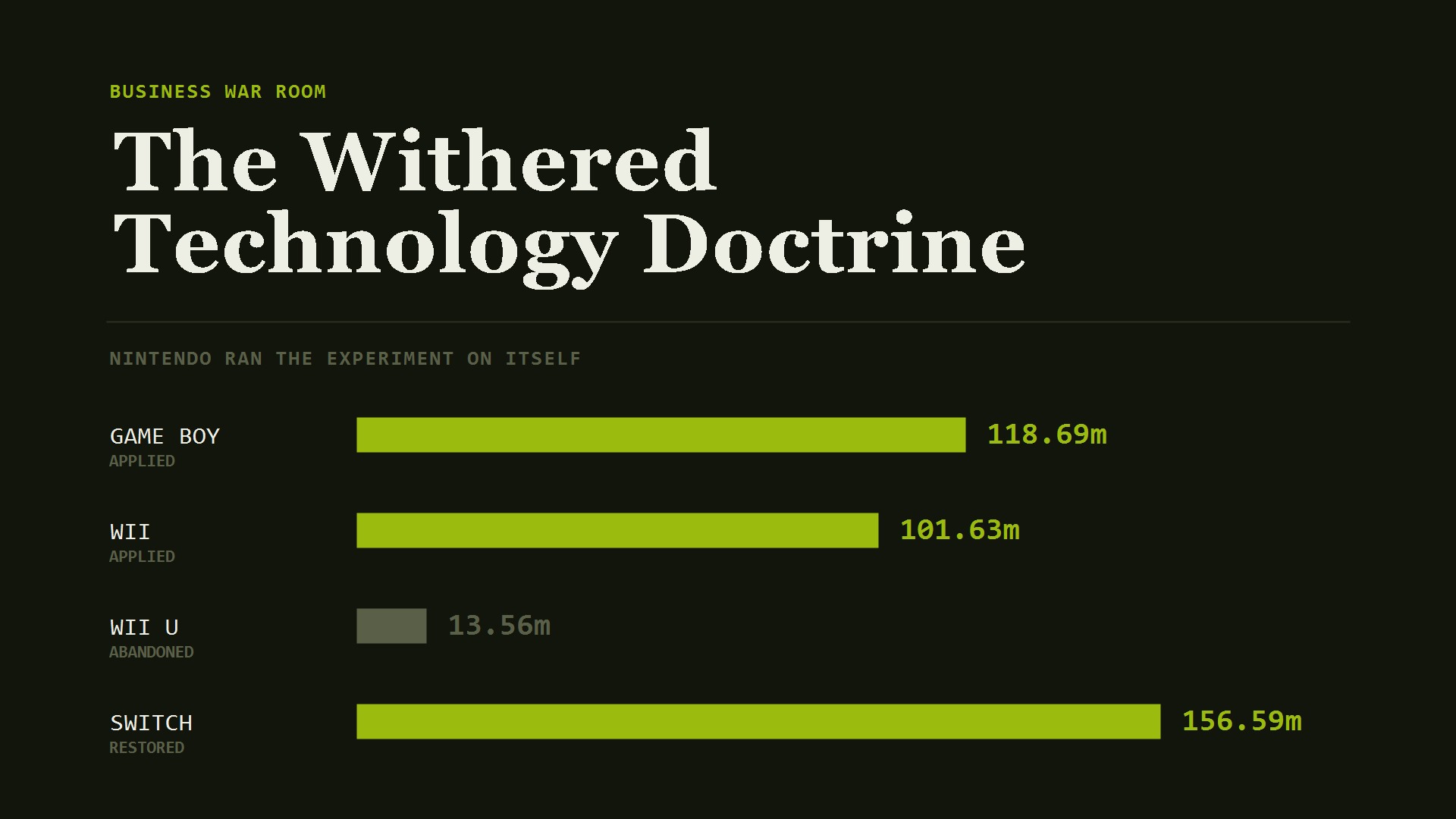
That sequence is the closest thing business strategy has to a controlled trial, and it is why this is a doctrine rather than a folk tale about a clever engineer.
This is the same logic that lets Garmin survive Apple entering its market by refusing to fight on the axis Apple chose, and it is the hardware version of what A24 does with 15 million dollar budgets against studios spending twenty times more.
The Uncomfortable Present: Nintendo Is Testing Its Own Doctrine
Here is where this stops being a history lesson.
The Switch 2, launched on 5 June 2025, is not a withered technology product. It runs a custom Nvidia processor with an Ampere architecture GPU, 12GB of LPDDR5X memory, DLSS upscaling and 4K output while docked. It is a specification machine.
Commercially it has worked so far, and spectacularly. It sold 3.5 million units in four days and 5 million inside its first month, the largest hardware launch in the industry’s history, passing 10 million by the end of September 2025. Nintendo raised its own forecast from 15 million to 19 million for the fiscal year.
So is the doctrine dead?
The more useful reading is that Nintendo has moved the withered technology one level up the stack. The hardware is now conventional. What remains deliberately mature is the play pattern, the franchises and the form factor, all of which are decades old and thoroughly understood. Reporting also points to longer development cycles and higher budgets on the new machine, which is precisely the cost structure Yokoi’s doctrine was designed to avoid.
That tension is worth watching, and it is the reason to write about this now rather than treating it as a 1989 story. A company that spent forty years winning by refusing the arms race has entered the arms race. The next two years will show whether the brand and the franchises are strong enough to carry a cost structure the doctrine was built to prevent.
The Founder’s Playbook: Competing on the Axis Nobody Is Defending
1. Identify the axis everyone is fighting on
In every category there is one dimension the whole industry has agreed to compete on. Processor speed. Feature count. Headcount. Funding raised. Write it down. That axis is crowded, expensive and winnable only temporarily.
2. Find the constraint your customer actually feels
The Game Boy’s rivals won on screen quality and lost on battery life. Ask which constraint genuinely limits your customer’s use of the product. It is rarely the one on the specification sheet, because the specification sheet was written by your competitors.
3. Buy mature, not new
Mature inputs cost less, fail less and are available in volume. That applies to components, but it applies just as well to software stacks, hiring profiles and channels. Boring and well understood is a margin decision before it is a technical one.
4. Spend the saving where the customer can perceive it
The saving is only worth taking if it becomes price, reliability or experience. If it disappears into overhead you have simply built a cheaper product, which is a different and much weaker strategy. Margin engineering is only a moat when it is converted into something the buyer can feel, which is exactly the mechanism behind Porsche’s option list running in the opposite direction.
5. Do not abandon the position when the industry mocks it
Nintendo was called technically backward for two decades. The Wii U is what happened the one time it listened. Expect the criticism, and treat the arrival of that criticism as evidence the position is still unoccupied.
Nintendo did not win because it was more imaginative than Sony. It won because it found a cheaper cost base than its competitors could reach while they were busy outspending each other, turned that into price and reliability, and held the position for forty years while the industry called it backward.
You are almost certainly in one of those fights right now. Your version might be headcount, or funding raised, or a feature list nobody asked for.
Stop asking how to build something more advanced. Ask which expensive fight your industry has agreed to have, and what it would actually cost you to walk away from it.
The answer is usually less than you are paying to stay in it.

Tumisang Bogwasi
Tumisang Bogwasi is an award-winning entrepreneur and strategist sharing insights on business growth, leadership, and innovation.