The Moat That Broke: How Boeing Let Finance Outvote the Cockpit
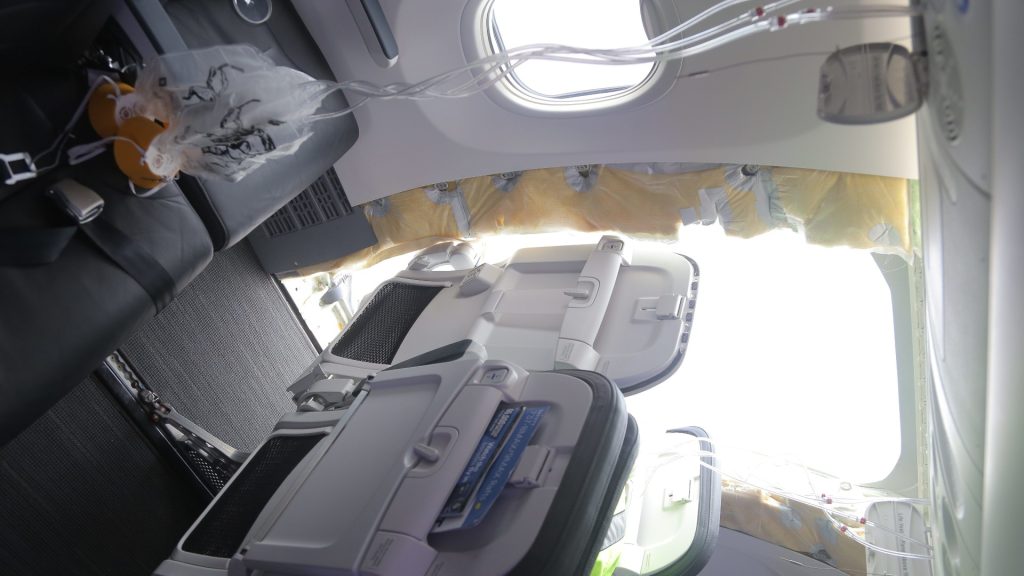
On January 5, 2024, a door plug tore off Alaska Airlines Flight 1282 six minutes after takeoff, at 14,830 feet. Nobody died. The National Transportation Safety Board later found that four bolts meant to hold the plug in place had been removed during a repair at Boeing’s Renton factory and never reinstalled, and that of the 24 people on Boeing’s door team, only one had ever been trained to remove a door plug panel.
I wrote about Intel handing TSMC the most valuable position in technology as a story of a company that stopped trusting its own process engineers. Boeing is the same failure with a different instrument. The moat was engineering excellence and the trust it bought from regulators, airlines and the flying public. It did not erode from a single bad decision. It eroded because, over three decades, the people who understood how an airplane is built stopped being the people who decided how it would be built. This is piece 3 of The Moat That Broke, a series on advantages that failed and the mechanism that killed each one.
The Pain Point: When the scorekeepers start running the game
Every engineering-led company eventually hires people whose job is to measure the business rather than build the product. This is necessary. Nobody can run a company the size of Boeing on engineering judgment alone. The same trap caught Nike when it pulled inventory decisions away from the wholesale partners closest to the shelf: a metric that looked cleaner from headquarters replaced judgment that only existed close to the product.
The trap is not hiring finance talent. The trap is letting the metrics finance talent produces become the primary language the company uses to make decisions that are actually engineering questions.
The single decision-rights failure
A cost projection and a load calculation are both numbers, but they are not the same kind of claim. One says what a supplier will charge. The other says what a wing spar can survive under stress. When both get evaluated on the same slide, by the same executive committee, using the same “does the math work” instinct, the engineering claim starts losing to the financial one, because financial claims are easier to defend in a room full of people who cannot check either.
Distance is a decision
A company can choose to put its decision-makers next to the product or away from it. Proximity is not sentimental. An executive who walks the factory floor daily absorbs friction that never makes it into a slide deck. An executive three time zones away only sees what gets escalated, and what gets escalated is filtered by people who know which numbers get approved.
The Radical Story: Three decisions, twenty-seven years
Boeing’s decline is traceable to a specific sequence, not a vague cultural drift.
1997: the merger that decided whose instincts would run the company. Boeing acquired McDonnell Douglas in an all-stock deal that closed on August 1, 1997, at a final value of roughly $16.3 billion, with McDonnell Douglas shareholders receiving 1.3 Boeing shares for each of theirs. Boeing was the larger, technically stronger company, but several McDonnell Douglas executives, including future CEO Harry Stonecipher, took senior roles in the merged company. They brought a management style built at a company that had spent the 1990s optimizing a shrinking military business for margin, not one that had spent decades pushing the frontier of commercial airplane engineering. Boeing’s own engineers began describing the shift as McDonnell Douglas buying Boeing with Boeing’s money.
2001: headquarters leaves the airplanes. On May 10, 2001, Boeing announced it would relocate its corporate headquarters from Seattle, where every commercial airplane program lived, to Chicago. CEO Phil Condit framed it as a location “central to our operating units, customers and the financial community, but separate from our existing operations,” so headquarters would not favor any one division. The move, completed September 4, 2001, put roughly 1,000 employees, mostly finance, strategy and legal staff, in an office more than 1,700 miles from the factories that built the product. The people approving engineering tradeoffs no longer worked near the people who had to live with them.
2004 to 2011: the 787 outsourcing experiment. With Stonecipher and later James McNerney, another executive from outside the engineering ranks, running the company, Boeing pushed design responsibility for the 787 to more than 50 international partners, betting that shared risk and lower capital outlay would outweigh the loss of direct engineering control. The result was three years of delay between the promised 2007 first flight and the actual 2011 entry into service, a shortage of fasteners, incomplete sub-assemblies arriving in Everett that Boeing’s own workers had to finish, and cost overruns Boeing eventually absorbed by buying back two struggling suppliers, Vought Aircraft’s Charleston operation and Global Aeronautica. The company had outsourced its own expertise, then paid to get it back.
2011 to 2019: the re-engineered airplane and the software patch. Facing Airbus’s fuel-efficient A320neo, Boeing chose to re-engine the existing 737 airframe rather than design a clean-sheet replacement. Between Q1 2013 and Q1 2019, Boeing spent $43.1 billion on share buybacks, more than its total profit over the same period. The re-engined MAX needed larger engines mounted differently, which changed its handling characteristics enough that Boeing built a software system, the Maneuvering Characteristics Augmentation System, to make it fly like the older model without requiring pilots to retrain in a simulator, a requirement that would have eroded the plane’s cost advantage to airline customers.
Why it broke
MCAS could push the plane’s nose down based on a single angle-of-attack sensor, with no cross-check against a second sensor and no disclosure to pilots that the system existed. Lion Air Flight 610 crashed on October 29, 2018, killing all 189 aboard. Ethiopian Airlines Flight 302 crashed on March 10, 2019, killing all 157 aboard. Both crashes were driven by MCAS reacting to a faulty sensor reading and repeatedly forcing the nose down while pilots who did not know the system existed fought to correct it. The two accidents killed 346 people and triggered a worldwide grounding that lasted 20 months.
The Department of Justice’s investigation found that two of Boeing’s own flight technical pilots had concealed MCAS’s expanded authority from the FAA during certification, specifically to avoid the simulator training requirement. In January 2021, Boeing agreed to pay $2.51 billion under a deferred prosecution agreement, admitting to one count of conspiracy to defraud the United States. In May 2025, after the Justice Department found Boeing had breached that agreement, the two sides reached a further deal requiring more than $1.1 billion in additional penalties and victim compensation.
The mechanism in one sentence: a decision that traded pilot retraining cost, a number finance could quantify, against a hidden flight-control authority change, a risk only engineers were positioned to see clearly, and the tradeoff was made by people who were rewarded for the number they could see.
2024: proof the fix never landed. The door plug blowout happened five years after the MAX grounding was lifted, on an airplane that had nothing to do with MCAS. The NTSB’s final report described the same underlying failure in different clothing: inadequate training, inadequate documentation, and inadequate oversight of work performed by Spirit AeroSystems, the supplier Boeing had spun off in 2005 and would go on to reacquire in an $8.3 billion deal that closed in 2025, an admission that separating airframe manufacturing from Boeing’s own quality system had been the wrong call twice.
What Boeing Never Stopped Doing Well
It would be dishonest to write this as a story about a company that lost the ability to build airplanes. The 787’s basic engineering, a composite airframe that cut fuel burn by roughly 20 percent against the aircraft it replaced, remains sound enough that airlines are still buying it in volume: Boeing took 321 787 orders in 2025, its second-best year for the program ever behind only its 2007 launch year, with Qatar Airways alone committing to up to 210 widebody jets. When Boeing’s engineers were finally the ones fixing the MAX’s flight control software, the fix held; no MCAS-related failure has recurred since. The problem was never that Boeing forgot how to design an airplane. It was that the people who could design one stopped deciding how urgently a known risk needed closing.
The Playbook: Keep the people who understand the product in the room where the decision gets made
1. Put decision-makers where the friction is
If you run anything that makes a physical or technical product, do not let senior leadership sit somewhere the product does not get built or used. Boeing’s 2001 move put a thousand miles between the people signing off on tradeoffs and the people who would discover, on the factory floor, whether those tradeoffs worked. Physical distance becomes organizational distance faster than any org chart shows.
2. Never let a financial metric silently substitute for a safety one
When a cost number and a technical risk assessment are both on the table, insist they get evaluated by different criteria, in front of the same decision-maker, with the technical expert able to veto on safety grounds regardless of the financial case. MCAS existed because a training-cost number was allowed to answer a question only a flight-control engineer should have answered.
3. Treat outsourcing as a transfer of control, not just cost
Before you push a core competency to a supplier, ask who inspects the work, who can reject it, and whether your own people still understand it well enough to catch what the supplier misses. Boeing’s 787 supply chain and its Spirit AeroSystems relationship both failed this exact question, seventeen years apart.
4. Reward the people who slow you down for the right reason
If your incentives only pay out for schedule and margin, you are training your best technical people to stop raising the objections that would have cost you both. Compare this to the discipline behind the Toyota Production System, where any line worker can pull an andon cord and stop the entire production line, and is protected, not penalized, for doing it. Boeing pulled authority up toward the balance sheet. Toyota pushed it down to the person closest to the defect.
5. Audit your own worst incident for repetition, not novelty
When something goes wrong, do not just ask what failed. Ask what decision-making pattern produced it, then check whether that pattern is still active anywhere else in the company. The 2024 door plug blowout was not a new failure mode. It was the 2018 and 2019 failure mode, training and oversight subordinated to schedule, wearing a different part number.
The Close
Toyota’s andon cord is the clearest counter-example in modern manufacturing: authority to stop everything sits with the person who can see the defect, not the person who can see the quarterly numbers. Boeing built the opposite structure by accretion, one merger, one headquarters move, one outsourcing bet at a time, until the authority to stop the line sat with people who had never worked the line.
Kelly Ortberg, who became CEO in August 2024, moved his own office back to the Seattle area and has told investors that quarterly results will sometimes take a back seat to getting the airplane right, an explicit reversal of the sequence that built the MAX. Whether that holds under the next quarter of pressure is the only test that matters.
A moat built on engineering trust does not fail because the engineers get worse. It fails when the organization stops asking them first.

Tumisang Bogwasi
Tumisang Bogwasi is an award-winning entrepreneur and strategist sharing insights on business growth, leadership, and innovation.