The Physicist’s Kid Who Built AI’s Assembly Line
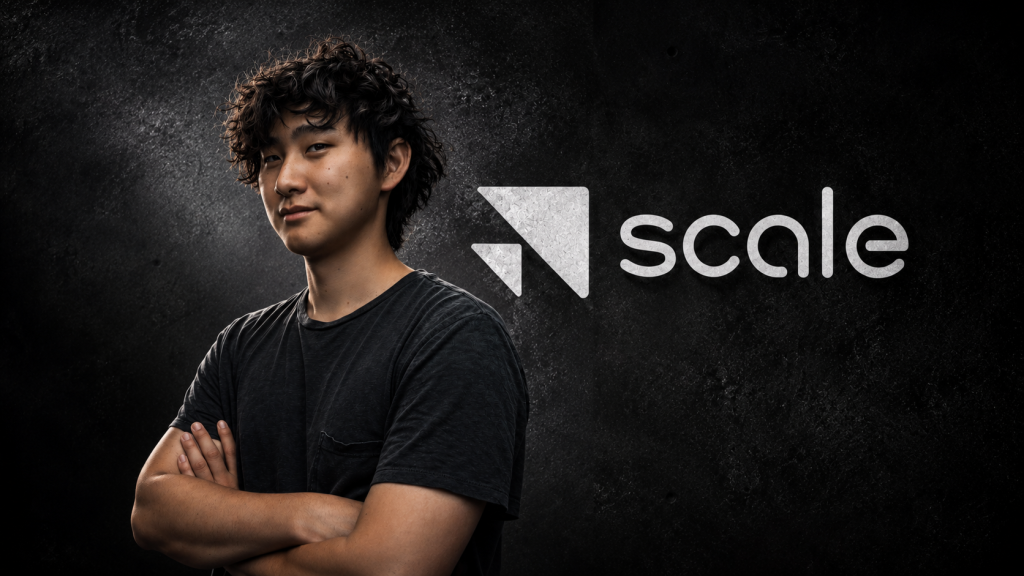
Alexandr Wang built the least glamorous business in artificial intelligence: paying people, by the hundreds of thousands, to label the data that teaches machines to think.
It made him, by Forbes’ count, the world’s youngest self-made billionaire. It also made him too valuable to stay neutral. His biggest customers started walking out within days of Meta writing a $14.3 billion check.
Every model rests on judgments someone made by hand
Every AI story this year is about bigger models, more GPUs and more electricity. Those are the costs a chart can show, and they sit on top of a cost almost nobody charts.
Before a model learns anything, a person has to look at an image, a sentence or a video and tell the machine what it is looking at.
Millions of those judgments, made by contractors far from the labs that need them, are what teach a frontier model to behave. Scale AI turned that work into an industry.
A kid from Los Alamos
Wang grew up in Los Alamos, New Mexico, the town built to develop America’s first atomic bomb. His parents were physicists at the national laboratory.
He was entering math competitions by sixth grade and physics olympiads through his teens. By 17 he was a full-time software engineer, first at Addepar, then at Quora, where he met Lucy Guo.
He enrolled at MIT to study machine learning and left in under a year. At 19 he joined Y Combinator’s 2016 batch with Guo, and the company they built there was Scale AI.
Guo was fired in 2018, reportedly after clashing with Wang over how Scale treated its contract workers. She kept roughly 3 percent of the company on the way out.
That stake later made her, by Forbes’ count, the youngest self-made woman billionaire. Wang kept building.
The product is human judgment, sold at industrial scale
Through its Remotasks and Outlier platforms, Scale pays a global contractor workforce, reportedly more than 240,000 people strong.
They annotate images and video for self-driving systems, label and rank text for large language models, and run reinforcement learning from human feedback, the step that turns a raw model into an assistant.
None of it is glamorous, and that is the point. Labs like to talk about parameters and benchmarks. It sits one layer below companies like Baseten renting out the GPUs that run those models.
Labelling at the volume a frontier model needs is a physical, human supply chain problem. Wang built the company that owns that supply chain.
Scale AI, by the numbers
- Founded 2016 by Alexandr Wang and Lucy Guo, out of Y Combinator
- August 2019: $100 million Series C led by Founders Fund, valuation past $1 billion
- May 2024: $1 billion Series F at a $13.8 billion valuation
- June 2025: Meta invests $14.3 billion for a 49 percent non-voting stake, valuing Scale at $29 billion
- 2025: more than $1 billion in new business booked, according to Scale
- August 10, 2026: Francis deSouza takes over as CEO; Wang remains chairman
Meta’s money made neutrality the product, then took it away
On June 12, 2025, Meta and Scale confirmed the deal: $14.3 billion for 49 percent of the company, structured as non-voting equity. Scale would stay independent. Wang would not.
He stepped down to become Meta’s Chief AI Officer, co-leading Meta Superintelligence Labs with former GitHub chief Nat Friedman. Jason Droege, the founder of Uber Eats, became interim CEO.
$14.3B
Meta’s price for a 49 percent non-voting stake, June 2025
The same deal that sent Scale’s largest customers looking for the exit.
Within days, the cost showed up on the customer list. Google, Scale’s largest customer, had planned to spend about $200 million with it in 2025, and was reported to be preparing to walk away.
The concern was simple: a vendor part-owned by a direct rival would see Google’s prototypes and research roadmap. OpenAI said it was winding down its own work with Scale, which it had been reducing for months.
Scale’s value to the industry had rested on being the vendor nobody had to worry about. Meta’s money bought Wang and a 49 percent stake. It also priced in the exit of the customers who had made that stake worth buying.
The company outgrew its founder twice
At Meta, the new structure was tested quickly. Yann LeCun, Meta’s chief AI scientist for more than a decade, announced in November 2025 that he was leaving to start his own company.
His exit came months into a reorganisation that placed a 28-year-old labelling founder above Meta’s research veterans, and much of the coverage read it as a verdict on that structure.
Scale, meanwhile, spent more than a year under Droege working through the customer exits. On July 30, 2026, the board named an outsider: Francis deSouza, formerly COO of Google Cloud and CEO of Illumina.
“There is no better person to lead Scale through this critical moment in AI than Francis.” Alexandr Wang, founder and chairman, Scale AI, July 2026
Scale rebuilt itself around enterprises and governments
The customers who left were frontier labs. The ones Scale went after next were not. In January 2026, Droege said Scale had booked more than $1 billion in new business in 2025.
He named BP, Mayo Clinic and Allianz as enterprise customers, and said the US Department of War had signed two contracts worth roughly $200 million. The original data business, he said, is now profitable.
That is a different company from the neutral labelling vendor of 2024. It now sells finished AI systems to buyers Palantir spent two decades learning how to sell to.
Hiring a Google Cloud operator as chief executive fits that shift. deSouza’s brief is enterprise and government growth, not frontier-lab relationships.
Founder lessons from the assembly line
Build the layer nobody else wants to build
Scale took the least prestigious job in the AI stack and treated it as a real company. A market with no competition is often a market nobody respects yet.
Equity outlives conflict
Guo was fired in 2018 and kept about 3 percent. Seven years and one Meta deal later, that stake made her a billionaire. A messy split does not end the cap table math.
If neutrality is the product, one investor’s money has a price
Meta’s cash rewarded Scale’s investors and gave Wang a new job. It also gave Scale’s biggest lab customers a reason to leave.
When you lose a market, sell to the buyers who remain
Scale replaced frontier labs with an oil major, a hospital system and a defence department, then hired a chief executive who knows that customer.
Final word
The real invention here was never a model. It was proof that the human labour behind every AI system is a business worth tens of billions, and that controlling it gives leverage over an entire industry.
That leverage also drew forces no founder can out-negotiate: rivals protecting their roadmaps, a new employer’s internal politics, and a board that decided the next chapter needed a different kind of chief executive.
Sources
- CNBC, Scale AI’s Alexandr Wang confirms departure for Meta as part of $14.3 billion deal, June 12, 2025
- CNBC, Google, Scale AI’s largest customer, plans split after Meta deal, sources say, June 14, 2025
- CNBC, OpenAI is winding down its work with Scale AI, whose founder is joining Meta, June 18, 2025
- TechCrunch, Data-labeling startup Scale AI raises $1B as valuation doubles to $13.8B, May 21, 2024
- CNBC, Meta chief AI scientist Yann LeCun is leaving to create his own startup, November 19, 2025
- Scale AI, Scale’s next era: building for 2026, January 22, 2026
- Scale AI, Scale AI appoints Francis deSouza as CEO to lead next phase of company’s growth, July 30, 2026
- Axios, Scale AI hires Francis deSouza, former Google Cloud executive, as new CEO, July 30, 2026
- Capacity, Scale AI cuts 14% of workforce following Meta investment and CEO departure, July 17, 2025
- Forbes, Alexandr Wang and Lucy Guo profiles, forbes.com, accessed September 2026

Tumisang Bogwasi
Tumisang Bogwasi is an award-winning entrepreneur and strategist sharing insights on business growth, leadership, and innovation.